New York City is for seeing
If you like this content consider treating me to a coffee or buying my prints.
When I started photographing in New York there was a ferry outside my apartment.
It ran up and down the East River and I could be on it in a few minutes, so I took an awful lot of photographs from the ferry, on the ferry…of the ferry. When I wasn’t on the ferry the subway took me straight into Grand Central, so I shot a lot around Grand Central.
Some of the reasoning was that they were simply there. I could just take them. I didn’t have to feel so overwhelmed by a location, and I didn’t feel overwhelmed by the camera, or the light, or the time of day, or how many people happened to be on the street that morning.
This isn’t a lesson in how to take photographs. It’s a lesson, I suppose, if we want to call it that, in how to see them.
If you’re new to the city you might want to hit the obvious places. The Staten Island Ferry, Times Square, Grand Central, Central Park, places like that. And as a tourist you may just want to document the fact that you were there, and that’s fine. I have those photographs too. Everyone does.
But as a photographer, or an aspiring one, or someone who gets out with a camera at weekends, there’s a real challenge in finding the less obvious photograph in a very obvious place.
Eventually I ventured further out. The High Line. In and around the East Village. And what I noticed was that I was still doing the same thing: photographing a statue, or a sign, or some particular feature of the area. There’s a sign in Central Park about not swimming in the pond. I photographed that. Nothing overly adventurous.
What I didn’t realise at the time was that I was building a muscle for seeing that I didn’t necessarily know I had.
The famous places aren’t a compromise. They’re where the learning happens, because everybody has the same access. You and I can stand on the same deck at Top of the Rock, on the same afternoon, in the same light, with the same railing in front of us. Nothing separates the two photographs except what each of us decided to look at.
That’s a rare thing. Usually when one photograph is different from another you can point at something: the weather, the light, luck, a place the other person couldn’t get to. Take all of that away and what’s left is the looking. Which means the beaten track isn’t the thing you graduate from. It’s the practice room.
I’ve put the locations of some of these photographs onto a map. Not a list of good spots to go and stand in. More a way of showing that they were all made in real places, most of them places you could get to this afternoon, if you live in NYC, and of seeing how many of them pile up in the same few.
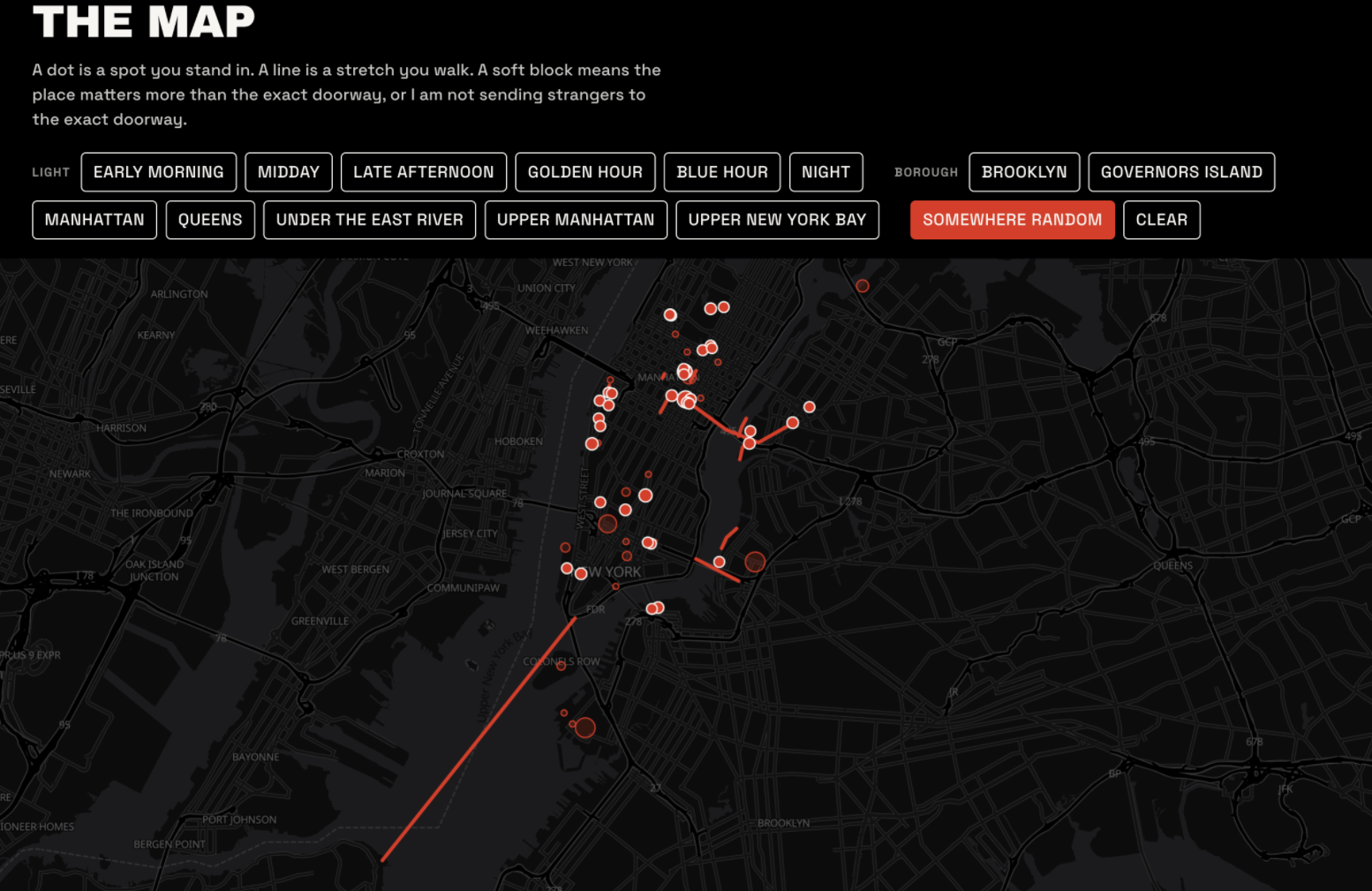
For example, nine of the photographs on it were made at Summit One Vanderbilt. Not nine around Midtown. Nine in the same building, across more than one visit, because I kept going back and it kept having something else in it.
At Top of the Rock. I have the view south, the one everybody goes up for, with the Empire State Building at the centre and One World Trade beyond it in the haze. It’s a great view and I’m glad I have it. From the north side of the same deck, there’s another one: a couple leaning on the concrete parapet with Central Park spread out grey and green below them. Same spot, ninety degrees of difference.
In Times Square. One of the frames from there has an enormous lit advertisement in it, a basketball player pointing out of a circle with a speech bubble beside her, and along the bottom edge the dark silhouette of somebody’s head cutting across the whole thing. In black and white it reads less like an advertisement and more like a shape. The billboards are what everyone stands there for, including me. This is still a billboard. It’s just not only about a billboard.
On the Staten Island Ferry. There’s the Statue of Liberty through the window reflections or reflections on reflections. There’s one with another passenger holding a phone up to it, which is the picture the crossing is for. And there’s one at dusk, of a woman at the rail with her hair up and a scarf over her shoulder, watching Lower Manhattan across the wake. Neither of those is the better photograph. They’re just two things that were available on the same boat.
None of these needed access to anywhere difficult. They needed standing in an obvious place for longer than was comfortable.
The map
The map is on this page. Seventy-four places, 139 photographs, pinned where I stood, or close to, with notes on light and timing as I write them. It’s free.
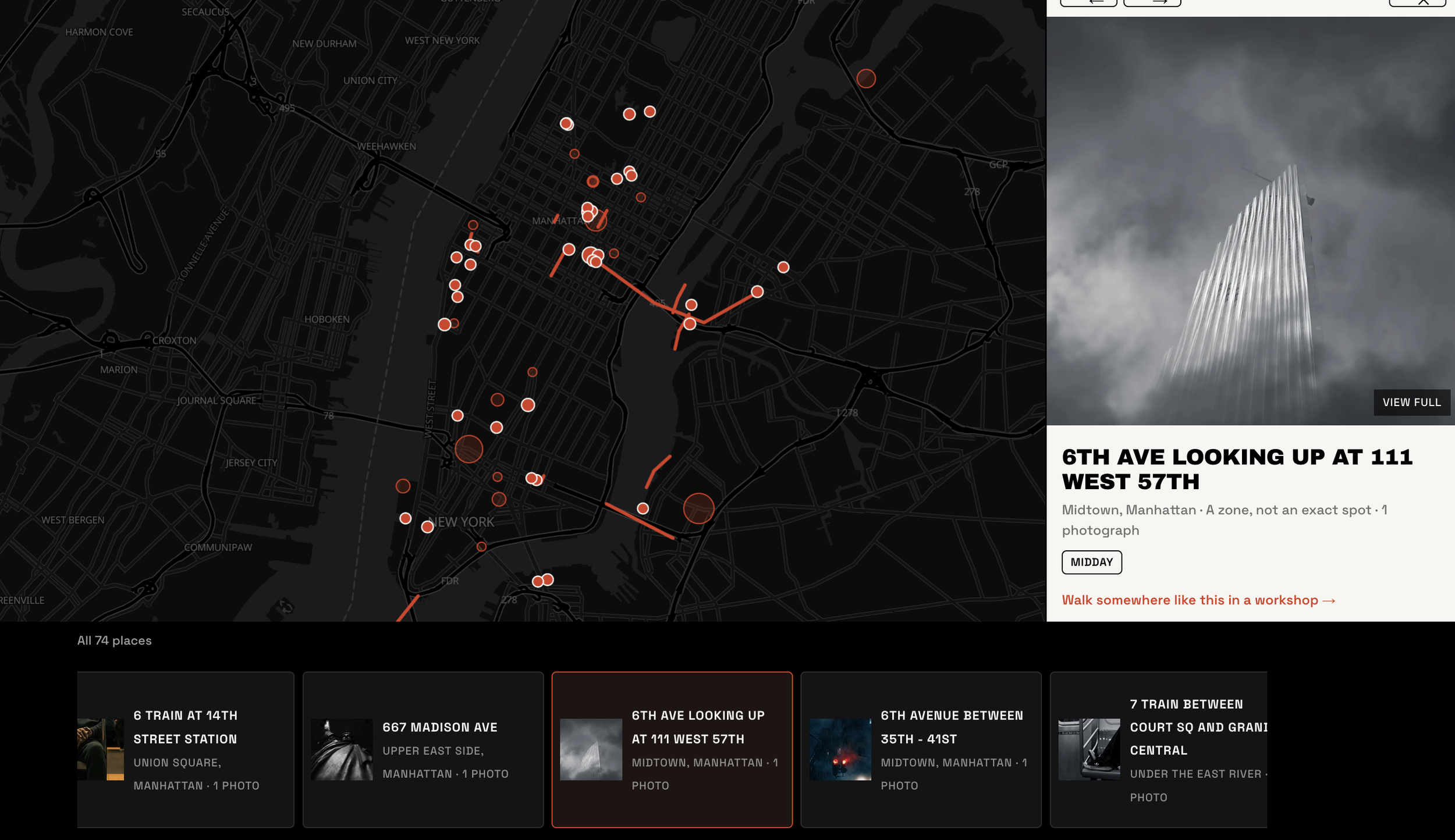
Some of the pins are exactly what they say. The Staten Island Ferry is plainly the Staten Island Ferry. Others you’d look at and have no idea where you were unless somebody pinned it for you, which is most of the fun of it.
One thing it isn’t. It’s not a list of shots to go and take. What I’d want it to be useful for is the other thing: that a place you’d written off after one visit usually has more in it than you might have expected. Or places that you hadn’t considered going that you might now consider.
It also isn’t finished. I’ll keep adding as I keep shooting, and the notes will fill in as I write them.
If you’ve got a famous location you keep going back to, and you’re still finding something new in it, I’d like to know which one and what you found. Those are the ones I want to add.
Paul
If you liked this content, consider treating me to a coffee. All images are available as prints.